Article 82 Saudi Labor Law protects a worker who falls ill: the employer may not end his service because of the illness before the worker has used up the sick leave the Law gives him.
The protection works together with Article 117, which sets the sick-leave periods and the pay for each, and with the worker’s right to attach annual leave to sick leave. In short, Article 82 Saudi Labor Law protects the worker while the sick-leave periods run.
This guide explains what each article says, what the worker should do, and what an employer must avoid. Anyone reading Article 82 Saudi Labor Law should keep medical reports and leave records, because they are the main evidence in a dispute.
What does Article 82 Saudi Labor Law say?
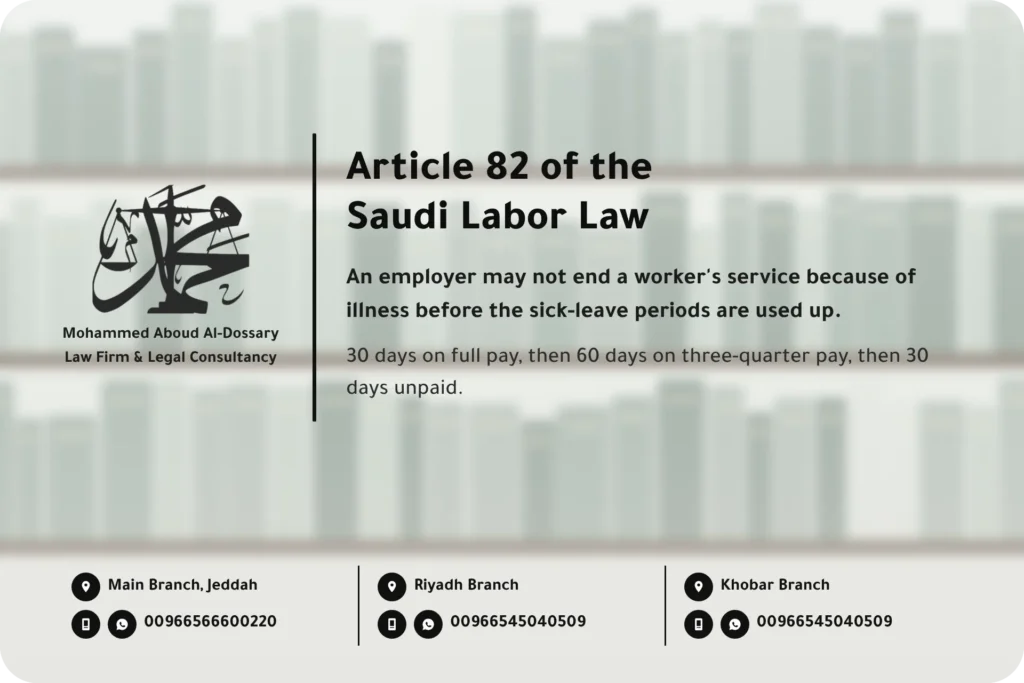
Article 82 contains two rules. First, the employer may not end the worker’s service because of illness before the worker has used the sick-leave periods set by the Law. Article 82 Saudi Labor Law does not allow the employer to use illness as the reason before those periods are used.
Second, the worker may ask that his annual leave be attached to his sick leave, which lengthens the period of protection and pay. Both rules in Article 82 Saudi Labor Law are aimed at giving the sick worker time to recover before his job is at risk.
The article does not itself deal with the end-of-service award. That is calculated under Article 84 and the related end-of-service rules when a contract ends. Article 82 Saudi Labor Law should therefore be read with Article 117 for the leave periods and Article 84 for the award.
The sick-leave periods in Article 117
| Period | Pay |
|---|---|
| First 30 days | Full wage |
| Next 60 days | Three-quarters of the wage |
| Next 30 days | No pay |
These limits apply within one year, whether the leave is continuous or in separate periods. The year is counted from the first day of sick leave.
The worker must prove his illness. Article 117 does not prescribe a specific certificate, but a report from a recognised health provider is the normal proof.
Employer obligations under Article 82
Read together with Article 117, Article 82 places these duties on the employer:
- No dismissal because of illness before the sick-leave periods are used up.
- Sick leave on the Article 117 terms: full pay for the first 30 days, three-quarters pay for the next 60 days, then 30 days without pay, within one year.
- Annual leave on request: the worker may ask for annual leave to be attached to his sick leave.
- No action that ends service because of the illness while the statutory periods are still running.
The burden of proving the illness is on the worker (Article 117). The law sets no fixed form, but a medical report from a health facility is the usual proof.
Does Article 82 apply to every type of contract?
Article 82 does not depend on the type of contract. It protects workers covered by the Labor Law, whether the contract is fixed-term or open-ended, and whether the worker is paid monthly or by the day.
The rule does not reach people outside the Labor Law, such as domestic workers, who have their own regulations. If you are unsure which regime covers you, check the contract and the employer’s registration before relying on Article 82.
When is dismissal during illness unlawful?
Ending the contract while the worker is still within his sick-leave periods, and because of the illness, breaches Article 82 Saudi Labor Law.
The employer may argue another reason, such as a violation or a restructuring. The burden then falls on the employer to show that the reason was genuine and not the illness.
What if the periods are used up?
Article 82 protects only until the periods are exhausted. It does not make every later dismissal lawful, and the employer must still follow the Law’s rules on notice and on the end-of-service award.
Article 79 also provides that a contract ends if the worker is unable to do the work, shown by a medical report from an authorised health body or a doctor appointed by the employer.
Annual leave and sick leave
Under Article 109, annual leave is at least 21 days a year, and at least 30 days after five continuous years of service.
Article 82 lets the worker ask for his annual leave to be attached to the sick leave. This is useful when the sick-leave periods are about to end.
On leaving, the worker is paid for unused leave under Article 111.
How a worker obtains sick leave
- Tell the employer about the illness as early as you can. Articles 82 and 117 set no fixed notice deadline, but delay makes the absence harder to defend.
- Prove the illness with a medical report from a health facility.
- Count the days inside the year that starts from the first sick day, using the 30 + 60 + 30 pattern in Article 117.
- Ask for annual leave to be attached if you need more rest after the sick-leave periods.
- Keep every report and the termination letter (if any). They are the evidence if the employer ends the contract early.
What can a sick worker do if he is dismissed?
- Keep the medical reports and the dates of the sick leave.
- Ask the employer for the written reason for ending the contract.
- Send a written objection that cites Article 82.
- If the dispute continues, file a labour case and claim the compensation for unfair termination described in Article 77.
Practical tip: send the medical report to the employer through a channel that leaves a record, such as email, and keep the delivery proof.
Common mistakes about Article 82 Saudi Labor Law
- Assuming the employer can end the contract at the first sick day.
- Taking sick leave without any proof of illness.
- Not asking to attach annual leave before the sick-leave periods end.
- Accepting a resignation letter prepared by the employer during illness.
Frequently asked questions
What does Article 82 of the Saudi Labor Law say?
The employer may not end the worker's service because of illness before the worker has used the sick-leave periods set by the Law. The worker may ask to attach his annual leave to sick leave.
How many sick-leave days does a worker get?
Under Article 117: 30 days at full pay, then 60 days at three-quarters pay, then 30 days unpaid, within one year.
Can the employer terminate a sick worker?
Not because of the illness before the sick-leave periods are exhausted. After that, the Law's rules on termination and end-of-service still apply.
Can the worker use annual leave instead of sick leave?
Yes. Article 82 allows the worker to ask that his annual leave be attached to the sick leave.
What proof of illness is needed?
The worker must prove the illness. A report from a recognised health provider is the usual proof.
What can a worker do if he is dismissed while on sick leave?
Object in writing citing Article 82 and, if needed, file a labour case claiming compensation for unfair termination.
Conclusion: use Article 82 together with Article 117
Article 82 Saudi Labor Law protects a sick worker from dismissal because of illness until the sick-leave periods in Article 117 are used up. Keep the medical reports, ask to attach annual leave when needed, and object in writing if the employer ends the contract.
Dismissed while sick or on medical leave? Send us the medical reports and the termination notice on WhatsApp and a lawyer will check Articles 82 and 117 and your options. You can also browse our legal services.

Mohammed Aboud Al-Dossary is an experienced Saudi lawyer with more than 15 years of legal experience in practice and legal consultancy. He is currently General Manager of Mohammed Aboud Al-Dossary Law Firm and Legal Consultancy, which provides specialized legal services in a range of fields, including corporate matters, criminal cases, intellectual property, family cases and commercial disputes.
The firm provides integrated legal consultancy for individuals and companies in the Kingdom of Saudi Arabia. In his work, Mohammed Aboud Al-Dossary focuses on close attention to the details of each case and on pursuing justice for his clients.
His legal experience
More than 15 years practicing law in the Kingdom of Saudi Arabia.
Specialized legal consultations for individuals and companies.
Expert in commercial arbitration, litigation and criminal cases.
Team leader in handling complex cases across the Kingdom’s courts.
Chairman of the Board
As founder and general manager of Mohammed Aboud Al-Dossary Law Firm and Legal Consultancy, he supervises all legal operations and directs a team of lawyers.