Article 77 Saudi Labor Law is the compensation rule for ending an employment contract without a valid reason, where the contract itself does not fix an amount. It does not say when an employer may dismiss a worker, and it is not an alternative to notice or to end-of-service pay.
This guide explains what the article covers, how the compensation is calculated for open-ended and fixed-term contracts, the two-month minimum, how it differs from Articles 75, 76 and 80, what evidence to gather, and the route for claiming it. The wording follows the Saudi Labor Law as amended.
Quick answer: what the Article 77 Saudi Labor Law rule provides
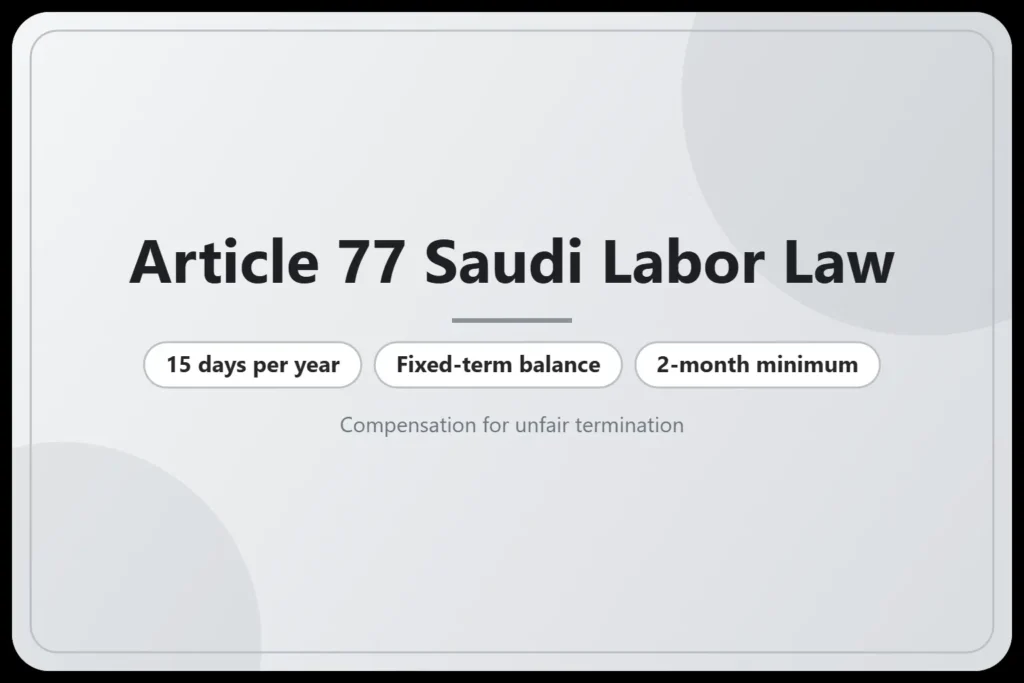
Where a contract is ended without a valid reason and the contract fixes no specific compensation, the party harmed is entitled to compensation. It is worked out differently for each type of contract, and it can never fall below two months’ pay.
| Type of contract | Compensation under Article 77 |
|---|---|
| Open-ended contract | 15 days’ pay for each year of service |
| Fixed-term contract | Pay for the remaining term of the contract |
| Either type | Never less than two months’ pay |
This compensation can sit alongside payment in lieu of notice, end-of-service benefits and unpaid salary or leave, depending on the facts. Asking only “how much is the Article 77 amount?” therefore rarely gives the full picture of what is owed.
Was your contract ended and you are unsure what you are owed? The answer turns on the contract type, the reason given and your payslips. A labor lawyer can review your contract and the termination and estimate the compensation due under the Saudi Labor Law.
What Article 77 means, and what it does not
The article sets a rule of compensation for the party harmed when a termination had no valid reason and the contract itself says nothing about compensation. The common mistake with the Article 77 Saudi Labor Law rule is to read it as the “dismissal article”, or as a price an employer can pay to end a contract at will.
The analysis starts earlier. Did the contract end for a valid reason? Was proper notice given? Was there a serious breach? Is the contract fixed-term or open-ended? Only after these questions does the amount come into play.
Article 77 Saudi Labor Law compared with the neighbouring articles
| Article | The question it answers | Practical effect |
|---|---|---|
| 74 | When does a contract end? | Ending in the cases the law lists |
| 75 | How is an open-ended contract ended? | Written notice, with set minimum periods |
| 76 | What if the notice period is not respected? | Compensation equal to pay for the notice period |
| 77 | What if the termination had no valid reason? | Compensation to the harmed party by contract type |
| 80 | When may an employer dismiss without notice, end-of-service pay or compensation? | Serious cases listed in the article |
Article 77 and Article 75: notice versus compensation
Article 75 deals with ending an open-ended contract for a valid reason by written notice. Under the amended text, where pay is monthly the worker gives at least 30 days and the employer at least 60 days, and where pay is not monthly the notice is at least 30 days.
Article 77 is not about the length of notice. It is about compensation when the termination itself had no valid reason. Merging the two articles is one of the most frequent errors in online summaries.
Article 77 and Article 80: compensation versus dismissal for cause
Article 80 lists the serious cases in which an employer may end the contract without end-of-service pay, notice or compensation, provided the worker was given the chance to state his objections. Many disputes are really about which article fits the facts: a termination without a valid reason under Article 77, or a dismissal for cause under Article 80.
How to calculate compensation under Article 77 Saudi Labor Law
The compensation depends on the type of contract. The examples below use the monthly wage and show where the two-month floor changes the result.
Open-ended contract: 15 days’ pay per year of service
Example 1. A worker earns SAR 8,000 a month and has served 4 years. Fifteen days’ pay is SAR 4,000, and SAR 4,000 multiplied by 4 years is SAR 16,000. Two months’ pay is also SAR 16,000, so the compensation is SAR 16,000.
Example 2. A worker earns SAR 6,000 a month and has served one year. Fifteen days’ pay is SAR 3,000, but the two-month minimum applies, so the compensation is SAR 12,000, not SAR 3,000. Short-service cases are where the floor matters most.
Fixed-term contract: pay for the remaining term
Example 3. A worker earns SAR 7,000 a month and has 5 months left on the contract when it is ended without a valid reason. The compensation is SAR 7,000 multiplied by 5, which is SAR 35,000. That is above the two-month minimum, so SAR 35,000 is due.
These figures are illustrations only. The result depends on how the contract defines wages, the actual termination date and any specific compensation clause.
Which wage counts: basic pay or total pay?
Official awareness material on the Article 77 Saudi Labor Law rule speaks of the worker’s wage, but the practical dispute often turns on how the contract and payslips define it, and on whether allowances are fixed and recurring. The disagreement can be about the calculation base as much as about entitlement, so check the contract wording before relying on a quick estimate.
Is Article 77 compensation the same as end-of-service pay?
No. Compensation under the Article 77 Saudi Labor Law rule arises from a termination without a valid reason. End-of-service benefits are a separate right, calculated on years of service and the last wage under the articles on the gratuity. In one case a worker may be owed:
- compensation under Article 77;
- pay in lieu of notice;
- end-of-service benefits;
- unpaid wages, leave or other dues.
For how the gratuity is worked out, see our guide to the Saudi Labor Law. The same rules also matter in an unfair dismissal claim in Saudi Arabia, where each head of claim is stated separately.
Common mistakes that weaken an Article 77 Saudi Labor Law claim
- Treating every ended contract as an Article 77 case. A contract may end in the cases of Article 74, by valid notice under Article 75, or by dismissal under Article 80.
- Mixing compensation with pay in lieu of notice. Notice pay belongs to Article 76 and compensation for a termination without a valid reason to Article 77. Both can be owed.
- Ignoring the contract type. Fixed-term and open-ended contracts are calculated differently, and a fixed-term contract that keeps running may be treated as open-ended.
- Forgetting the two-month floor. Even when the formula gives less, the compensation cannot fall below two months’ pay.
- Asking “how much?” and forgetting “how do I prove it?”. A claim is built on documents, not on arithmetic.
Does your case fall under Article 77 Saudi Labor Law? Five checks
- Did the relationship end only because the contract term expired, or was it ended early or suddenly?
- Is the contract fixed-term or open-ended?
- For an open-ended contract, was proper written notice given?
- Could the employer rely on a serious ground under Article 80?
- Does the contract itself fix compensation for termination?
If the answers are unclear, the difficulty is usually the legal description of the facts rather than the arithmetic. A short consultation is often more useful than piecing together general summaries.
How to claim after a termination without a valid reason
When the matter is not resolved directly, the Ministry of Human Resources and Social Development offers an electronic amicable settlement service for labor disputes through its services portal. The usual sequence is:
- Sign in to the individuals portal, or the establishments portal if the claimant is an establishment.
- Choose the amicable settlement service and start a new claim.
- Complete the mandatory fields of the statement of claim and select the subject of the claim.
- Attach the required documents.
- Accept the declaration that the claim is made in good faith.
- Submit the request.
Documents to gather first
- The contract and any amendments or renewals.
- Proof of the type, reason and date of termination.
- Any notice letters or messages.
- Payslips or wage statements.
- Proof of the remaining term or of the years of service.
- Any release form or settlement offer you were given.
An organised timeline improves the chance of a fair settlement or a more precise claim. Workers also have separate rights when absent through illness, covered in our guide to the Saudi Labor Law.
Frequently asked questions
Is Article 77 the same as unfair dismissal?
Not automatically. Article 77 provides compensation when a contract is ended without a valid reason and the contract fixes no amount. First check the reason for termination and how it relates to Articles 74 and 80 and to the notice rules.
How much is compensation under Article 77?
It depends on the contract. For an open-ended contract it is 15 days' pay for each year of service, and for a fixed-term contract it is pay for the remaining term. In both cases it cannot be less than two months' pay.
Does Article 77 include end-of-service benefits?
No. End-of-service benefits are a separate right and can be owed together with Article 77 compensation, pay in lieu of notice and other dues, depending on the facts.
Can Article 77 apply to an employer as well as a worker?
The article speaks of the party harmed by the termination, so it is not limited in theory to one side. In practice it is usually invoked by workers.
Does not renewing a contract mean Article 77 compensation?
No. A contract that ends when its term expires, in the cases the law allows, is different from a termination without a valid reason, which is what opens the compensation.
Is notice pay part of Article 77 compensation?
Not necessarily. Notice pay is linked to Article 76 and compensation for a termination without a valid reason to Article 77. Both may be owed in the same case.
Start with the legal description, then the number
Article 77 Saudi Labor Law gives compensation for a termination without a valid reason: 15 days’ pay per year for an open-ended contract, the remaining term for a fixed-term one, and never less than two months’ pay. Establish the contract type and the reason for termination before you calculate.
Not sure whether your termination falls under Article 77? Send us your contract, payslips and the termination notice on WhatsApp and a labor lawyer will assess what you may be owed. You can also browse our legal services.

Mohammed Aboud Al-Dossary is an experienced Saudi lawyer with more than 15 years of legal experience in practice and legal consultancy. He is currently General Manager of Mohammed Aboud Al-Dossary Law Firm and Legal Consultancy, which provides specialized legal services in a range of fields, including corporate matters, criminal cases, intellectual property, family cases and commercial disputes.
The firm provides integrated legal consultancy for individuals and companies in the Kingdom of Saudi Arabia. In his work, Mohammed Aboud Al-Dossary focuses on close attention to the details of each case and on pursuing justice for his clients.
His legal experience
More than 15 years practicing law in the Kingdom of Saudi Arabia.
Specialized legal consultations for individuals and companies.
Expert in commercial arbitration, litigation and criminal cases.
Team leader in handling complex cases across the Kingdom’s courts.
Chairman of the Board
As founder and general manager of Mohammed Aboud Al-Dossary Law Firm and Legal Consultancy, he supervises all legal operations and directs a team of lawyers.