Legal content prepared by:
Attorney Mohammed Aboud Al-Dossary
Licensed attorney in the Kingdom of Saudi Arabia — License No. 40462.
Last legal-source review: 17 October 2026
Saudi Labor Law is the principal legal framework governing employment relationships in much of Saudi Arabia’s private sector. It regulates employment contracts, wages, working hours, leave, overtime, occupational protection, termination and several rights specific to working women.
The law is designed to define the rights and obligations of both workers and employers rather than protect only one side of the employment relationship. Its practical effect depends on the employment contract, the worker’s status, the type of claim and the statutory provision governing the issue.
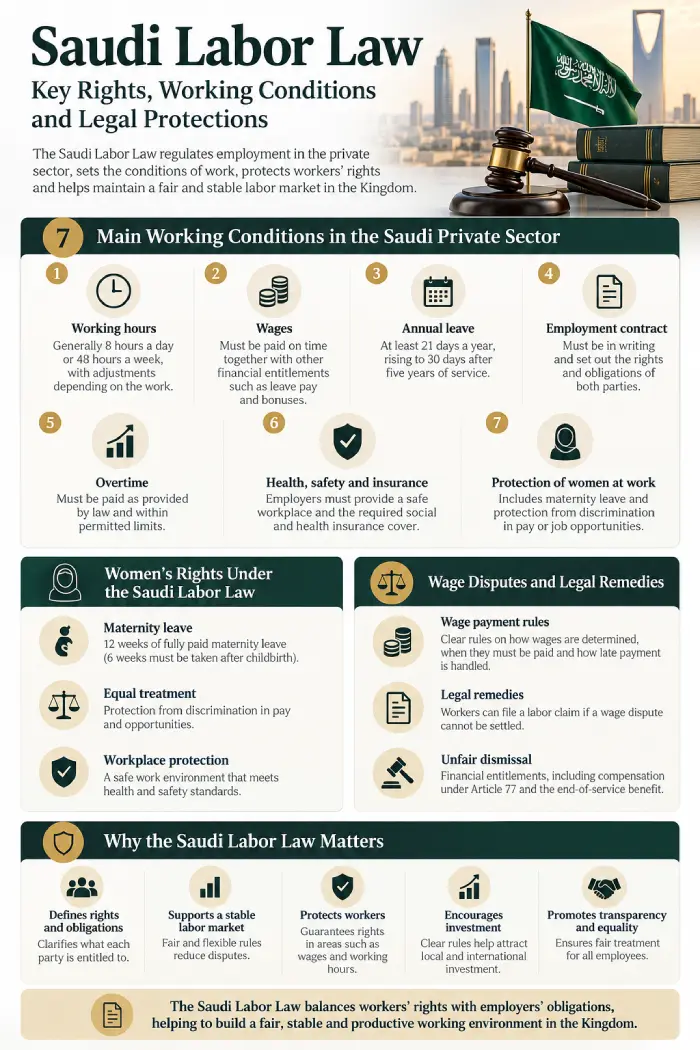
This guide explains seven core private-sector working conditions, women’s employment rights, wage disputes, unlawful termination and the main routes available when an employment disagreement cannot be resolved directly.
Quick answer:
Saudi Labor Law generally regulates employment contracts, wages, working hours, leave, overtime, occupational protections and termination. The ordinary working-time limit is eight hours per day or forty-eight hours per week, annual leave starts at no less than twenty-one days, and working women are entitled to twelve weeks of fully paid maternity leave under the current law.
Scope note
This article focuses on ordinary private-sector employment relationships covered by the Labor Law. Domestic workers and certain other categories are excluded from some general Labor Law provisions or are governed by separate regulations. The applicable legal framework should therefore be identified before relying on a general employment rule.
Facing delayed wages, a termination notice, or uncertainty about your employment contract in Saudi Arabia? A focused review of your contract, payment records and key dates can help clarify your legal position and identify the appropriate next step under Saudi Labor Law.
Request an Employment Issue Review
Prefer to understand the rules first? Continue reading the guide below.
What Does the Saudi Labor Law Regulate?
The Labor Law defines an employment contract as a relationship in which a worker performs work under the management or supervision of an employer in return for a wage. From that relationship arise duties on both sides concerning performance, payment, workplace conduct and the continuation or termination of the contract.
Its provisions cover subjects such as recruitment, employment contracts, wages, working hours, rest periods, overtime, annual leave, occupational safety, work injuries and employment termination. Separate provisions also regulate the employment of women and other specific categories.
The correct rule under Saudi Labor Law in a particular dispute therefore depends on more than the general principle that an employee has rights. The contract terms, dates, wage structure, notices, workplace regulations and evidence may all affect the legal outcome.
7 Working Conditions in the Saudi Private Sector
The following seven areas form the practical core of many private-sector employment relationships. They are also among the most common sources of questions when an employee or employer needs to determine whether a workplace practice is consistent with the Labor Law.
1. Working Hours and Rest Periods
The general rule is that a worker may not actually work for more than eight hours per day where the daily standard is used, or more than forty-eight hours per week where the weekly standard is used. Different limits may apply to certain categories or types of work in accordance with the law and its implementing rules, as explained in the official MHRSD guidance on working hours and overtime.
For Muslim workers during Ramadan, actual working hours are reduced to no more than six hours per day or thirty-six hours per week.
The rules also regulate rest periods. A worker generally should not work for more than five consecutive hours without a break for rest, prayer and food, subject to the applicable statutory exceptions.
2. Wages and Payment of Financial Entitlements
The employer must pay the wage in accordance with the contract and the statutory wage-payment rules. Monthly-paid workers are generally paid once a month, while different payment periods apply to daily-paid or piecework workers.
The concept of wage may include more than basic salary. Depending on the contract and workplace regulations, it may also include due allowances, commissions, increments or other elements that legally form part of the worker’s remuneration.
A bonus should not automatically be treated as a statutory entitlement in every employment relationship. Whether a particular bonus or reward forms part of the worker’s rights depends on the contract, workplace regulations, established practice and the applicable legal rules.
3. Annual Leave and Official Holidays
A worker is entitled to paid annual leave of not less than twenty-one days for each year of service. The minimum increases to thirty days once the worker has completed five consecutive years with the same employer.
Annual leave is a statutory entitlement and normally must be taken during the year in which it becomes due. The employer may schedule leave according to work requirements while complying with the applicable notice and postponement rules.
Saudi labor rules also provide paid leave for specified holidays and occasions. Work performed during official holidays is treated as overtime for the purpose of the applicable overtime provisions.
4. Employment Contracts and Documentation
Article 51 requires an employment contract to be written in two copies and documented in accordance with the applicable statutory requirements. Each party retains a copy, and the contract should contain the principal terms governing the employment relationship. The Ministry of Human Resources and Social Development’s official labor guidance also provides information on employment contracts and workers’ contractual rights.
However, an employment relationship does not automatically cease to exist merely because no written contract was produced. The Labor Law expressly recognizes that a contract may still exist even if it is not written, and in that situation the worker may prove the contract and rights arising from it through legally accepted methods of proof.
Documenting the contract through the applicable official platform remains important because it reduces uncertainty about the agreed wage, job, duration and other contractual terms and may affect the procedural options available in a later dispute.
5. Overtime and Compensatory Leave
Under Article 107, overtime generally attracts additional compensation calculated according to the statutory formula. The employer must pay the worker an additional wage for overtime equivalent to the hourly wage plus fifty percent of the basic hourly wage. The applicable rules are outlined in the official MHRSD guidance on working hours and overtime.
The current rules also permit paid compensatory leave instead of overtime pay where the worker agrees and the applicable requirements are satisfied. This means overtime does not always have to be resolved only through additional cash payment when a lawful compensatory-leave arrangement has been agreed.
Hours worked on official holidays are treated as overtime hours. Annual limits and other controls may also apply under the implementing regulations.
6. Occupational Safety, Health and Statutory Protection
Employers must comply with the occupational safety and health duties applicable to their workplaces. These duties are intended to reduce occupational risks, prevent injuries and maintain a suitable working environment.
Health-insurance and social-insurance obligations are also governed by the relevant Saudi laws and regulations. The applicable implementing rules require establishments to comply with health-insurance obligations and occupational-hazard social-insurance requirements where they apply.
For that reason, workplace safety, health insurance, social insurance and work-injury protection should not all be treated as a single entitlement arising from one Labor Law provision. Different legal instruments may govern different parts of the worker’s protection.
7. Protection Against Discrimination and Rights of Working Women
Saudi employment rules contain protections relating to equality and non-discrimination in the workplace. Article 3 addresses discrimination in the right to work, including discrimination based on sex, disability, age and other prohibited forms of discrimination within its statutory scope.
The implementing rules also prohibit wage discrimination between male and female workers performing equal work. Employers must additionally maintain a suitable and safe work environment in accordance with the applicable employment and occupational-safety requirements.
Working women also benefit from specific statutory rights concerning maternity leave and other employment circumstances, which are discussed below.
Rights and Obligations of Workers and Employers
Saudi Labor Law does not impose obligations only on employers. Workers are also required to perform the agreed work, comply with lawful instructions, observe workplace requirements and respect the duties arising from their employment relationship.
Employers, in turn, must meet their contractual and statutory obligations, including wage payment, lawful workplace treatment, leave entitlements and applicable safety requirements.
Article 80 identifies specific situations in which an employer may terminate an employment contract without an award, advance notice or compensation, subject to the statutory conditions and the worker being given an opportunity to state the reasons for objecting to the termination. It should not be treated as a general power to dismiss a worker without examining the facts.
Women’s Rights Under the Saudi Labor Law
The Labor Law contains specific protections for working women in addition to the general rules governing the employment relationship. These provisions are particularly important in relation to maternity, workplace safety and discriminatory employment practices.
Maternity Leave: 12 Weeks With Full Pay
Under Article 151, a working woman is entitled to twelve weeks of fully paid maternity leave. The six weeks following childbirth are mandatory.
She may distribute the remaining six weeks as permitted by the law, starting from four weeks before the expected date of delivery. The expected delivery date is determined through a medical certificate certified by a health authority.
Additional provisions apply where childbirth is delayed beyond the expected date and where the child is sick or has special needs requiring continuous accompaniment.
Equal Treatment and Wage Protection
Saudi labor rules prohibit discriminatory employment practices within their applicable scope, while the implementing regulations specifically prohibit wage discrimination between male and female workers performing equal work.
The legal assessment of a discrimination complaint nevertheless depends on the actual employment terms, the compared positions, duties, wage components, qualifications and the evidence showing how the employer treated the workers concerned.
Safe Working Environment
Employers are responsible for complying with the applicable workplace and occupational-safety requirements for male and female workers. Certain implementing provisions also contain specific workplace protections relating to female employees.
A worker who believes that a workplace practice violates a statutory protection should preserve documents, communications, policies and any evidence showing the practice complained of before selecting the appropriate complaint route.
Wage Disputes in Saudi Arabia: What Changed by 2026?
Under Saudi Labor Law, wage disputes are no longer accurately described by saying that every unpaid-salary case must simply begin with a labor lawsuit. Saudi Arabia has introduced an additional enforcement route for qualifying wage claims based on authenticated employment contracts.
In October 2025, the Ministry of Human Resources and Social Development and the Ministry of Justice adopted the wage clause in an authenticated employment contract as an executive instrument, using integration between Qiwa, Najiz and Mudad.
The rollout took place in phases and, according to the official timetable, the third phase began on 6 August 2026. This makes the distinction between an ordinary labor dispute and a qualifying direct wage-enforcement request particularly important in October 2026.
When May a Wage Clause Be Enforced Through Najiz?
According to the official mechanism, the employment contract must be authenticated through Qiwa and must have an execution number issued through the Ministry of Justice’s documentation framework.
Where the qualifying requirements are met, an employee who has not received the full wage within thirty days from its due date, or who has received only part of the wage after ninety days, may submit an electronic execution request through Najiz. The other party retains the right to object within the prescribed period.
This mechanism should not be confused with every possible wage dispute. Questions concerning the amount legally due, termination compensation, disputed commissions, leave balances or other contested employment rights may still require the appropriate labor-dispute process depending on the nature of the claim.
How Are Other Labor Disputes Resolved?
For labor disputes that require adjudication, the Ministry of Human Resources and Social Development provides the Friendly Settlement for Labor Disputes service. The Ministry describes friendly settlement as the first stage for considering labor disputes between workers and employers.
The process is designed to clarify the legal positions of the parties, review the necessary documents and attempt to reach an amicable solution. Where settlement cannot be achieved, the matter may be referred to the Labor Court in accordance with the applicable procedure.
The correct path under Saudi Labor Law therefore depends on the type of dispute. A qualifying wage claim supported by an authenticated executive instrument may follow a different route from a disputed termination claim or disagreement over employment-contract rights.
Practical Evidence Block: What to Check Before Filing
| Item | What to verify |
|---|---|
| Employment relationship | Employment contract, Qiwa record or other legally relevant evidence proving the employment relationship. |
| Claim documents | Salary records, bank statements, notices, termination documents, leave records, attendance data and communications relevant to the specific claim. |
| Friendly settlement fee | MHRSD currently lists the Friendly Settlement for Labor Disputes service as free. |
| Settlement pathway | MHRSD states that unresolved cases may be referred to the Labor Court within 21 working days from the first session. This describes the official service pathway and is not a guarantee of the total duration of a court case. |
| Direct wage enforcement | Check whether the Qiwa-authenticated employment contract carries the required execution number and whether the wage-payment conditions for a Najiz enforcement request are actually satisfied. |
Unlawful Termination and Article 77
Not every termination gives rise to Article 77 compensation. The first question is whether the employment contract was terminated for a reason that is legally valid under the applicable provisions and contractual terms.
Where a contract is terminated for an illegitimate reason and the contract does not contain a specific compensation provision, Article 77 provides a statutory compensation framework. The relevant statutory provisions can be reviewed through the official Saudi Labor Law published by MHRSD.
For an indefinite-term contract, the statutory formula is fifteen days’ wages for each year of the worker’s service. For a fixed-term contract, it is the wage for the remaining period of the contract. In either case, the statutory compensation under Article 77 must not be less than two months’ wages.
End-of-service benefits, unused leave, notice-period compensation and other accrued rights are separate questions and should be assessed under the provisions governing each entitlement rather than being treated as one automatic payment.
When Legal Review May Help in a Labor Dispute
A legal review is most useful where the dispute turns on documents, dates or the legal characterization of the employment event. Examples include disagreement over whether a termination was lawful, whether a payment is part of the wage, whether Article 80 applies, or whether a wage claim can proceed directly through enforcement.
Before seeking a case-specific assessment, it is useful to collect the employment contract, Qiwa records, salary statements, bank transfers, notices, correspondence, workplace policies and any document showing how and when the employment relationship changed.
Need help with a specific employment issue?
If your question depends on a specific employment contract, delayed wages, a termination notice or an existing labor claim, you can send a concise summary of the situation and the relevant documents so the appropriate legal route can be assessed.
Why the Saudi Labor Law Matters for Employers and Employees
The Labor Law provides a structured framework for employment relationships by defining rights, obligations and procedures before a dispute occurs. Clear rules on contracts, wages, leave and termination help both parties understand what is expected during the employment relationship.
For workers, Saudi Labor Law provides statutory protections and formal routes for claiming employment rights. For employers, it establishes the rules needed to manage contracts, working time, workplace conduct and termination in a more predictable manner.
Its practical importance is therefore not limited to court disputes. Many employment problems can be reduced by documenting contracts correctly, paying wages through the required mechanisms, preserving records and applying workplace decisions consistently with the current law.
Frequently Asked Questions About the Saudi Labor Law
What are the normal working hours under Saudi Labor Law?
The general statutory limit is eight actual working hours per day where a daily standard is used, or forty-eight hours per week where a weekly standard applies. For Muslim workers during Ramadan, the limit is reduced to six hours per day or thirty-six hours per week. Specific exceptions may apply to certain work.
How much annual leave does a private-sector worker receive?
A worker is entitled to annual leave of not less than twenty-one paid days for each year of service. The minimum rises to thirty days after five consecutive years with the same employer. Scheduling, postponement and payment for unused accrued leave are governed by the Labor Law and its implementing rules.
How long is maternity leave in Saudi Arabia?
A working woman is entitled to twelve weeks of fully paid maternity leave under Article 151. Six weeks following childbirth are mandatory, while the remaining six weeks may be distributed in accordance with the law, beginning from four weeks before the expected date of delivery as certified by a health authority.
What can a worker do if wages are not paid?
The correct route depends on the contract and the nature of the wage dispute. A qualifying Qiwa-authenticated contract with the required execution number may support direct electronic enforcement through Najiz under the wage-clause mechanism. Other disputed wage claims may proceed through MHRSD's friendly-settlement process and, if unresolved, the Labor Court.
Is an employment contract invalid if it was not written?
No. Article 51 requires employment contracts to be written and documented, but it also expressly states that a contract may still be considered to exist even when it is not written. In that situation, the worker may prove the contract and the rights arising from it through legally accepted methods of proof.
What compensation may apply after an unlawful termination?
If termination is for an illegitimate reason, Article 77 compensation may apply unless the contract provides a specific compensation mechanism. The statutory calculation differs between fixed-term and indefinite-term contracts and carries a minimum of two months' wages. Other entitlements, including end-of-service benefits and unused leave, are assessed separately.
Conclusion: Saudi Labor Law and the 7 Key Employment Rules
Saudi Labor Law provides the legal structure for employment contracts, wages, working hours, leave, overtime, workplace protection and termination in much of the Kingdom’s private sector. Understanding these rules helps workers and employers identify both their rights and their responsibilities before a disagreement develops.
The current framework also reflects important recent developments. Maternity leave is now twelve weeks with full pay, overtime may in qualifying cases be compensated through agreed paid leave, and authenticated wage clauses can provide a direct enforcement route for qualifying salary-payment violations.
When a dispute arises, the correct path depends on the actual documents and the type of right being claimed. A wage-enforcement request, friendly-settlement claim, Labor Court case and termination-compensation dispute are not interchangeable procedures.
Editorial Responsibility
Legal content prepared by
Attorney Mohammed Aboud Al-Dossary, a licensed attorney in the Kingdom of Saudi Arabia — License No. 40462.
The legal rules referenced in this guide were reviewed against official Saudi government sources on 17 October 2026.
Disclaimer:
This article provides general legal information about employment in Saudi Arabia. It is not a legal opinion on a specific employment relationship and does not create a lawyer-client relationship. The applicable result may differ according to the worker’s status, contract, workplace regulations, documents, dates and the facts of the dispute.
