
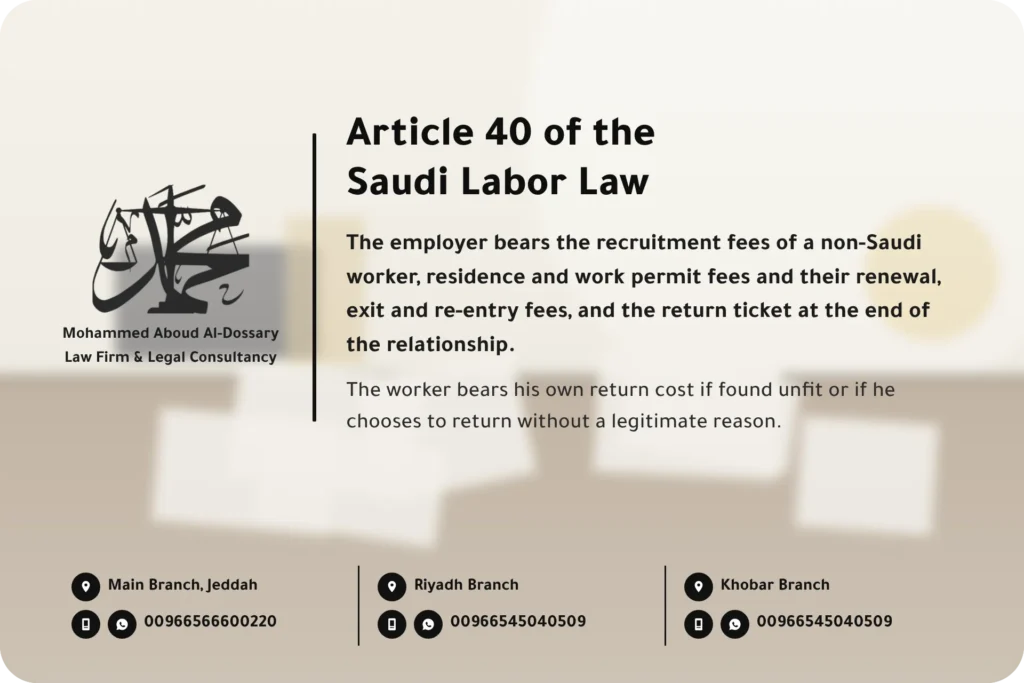
Article 40 Saudi Labor Law answers a question that appears in almost every contract with a non-Saudi worker: who pays the fees and the travel costs.
The starting rule is that the employer bears the costs linked to bringing in and keeping a foreign worker, with a short list of cases where the worker pays his own return cost.
This guide groups the costs in Article 40, explains the 2024 change on fines, and shows how to claim a cost the employer should have paid.
Article 40 Saudi Labor Law: what the employer pays
Article 40 places on the employer the fees and charges that arise from employing a non-Saudi worker. The Ministry of Human Resources and Social Development describes four groups.
| Group | Costs that fall on the employer |
|---|---|
| 1. Recruitment and residence | Recruitment fees, residence and work permit fees and their renewal, and the fee for changing the worker’s profession. |
| 2. Fines | Fines on late renewal of the permit or residence, when the delay was caused by the employer (2024 amendment). |
| 3. Travel | Exit and re-entry costs, and the return ticket to the worker’s home country when the relationship ends. |
| 4. Transfer and death | Transfer fees when the worker moves his services to the employer, and preparing and transporting the body when the worker dies. |
Any contract clause that shifts the costs in Article 40 Saudi Labor Law to the worker is open to challenge, because Article 40 is a rule that protects the worker.
What changed in the 2024 amendment to Article 40 Saudi Labor Law on fines?
Before the amendment, many workers were asked to pay fines that arose from late renewal of a permit or residence.
Under the amended text, the employer bears the fines that he caused. A fine that the worker caused personally, for example by hiding from work, is a different matter and is judged on its facts.
Who pays the return ticket under Article 40 Saudi Labor Law?
The general rule is that the employer pays for the worker’s return to his home country when the employment relationship ends.
The worker pays his own return cost in two cases only: when he is found unfit for work, or when he returns without a legitimate reason.
These exceptions are narrow. An employer who ends the contract, or a worker who leaves because of the employer’s breach, does not fall under them.
Transfer of services
When a worker transfers his services to a new employer, the transfer fees are paid by the new employer, not by the worker.
Death of the worker
If the worker dies, the employer must prepare and transport the body to the place where the contract was made or the worker was recruited.
Two exceptions apply: the worker is buried in the Kingdom with the family’s consent, or the General Organization for Social Insurance (GOSI) bears the cost.
Employer and worker obligations under Article 40 at a glance
| Item | Who pays |
|---|---|
| Recruitment fees of a non-Saudi worker | Employer |
| Residence and work permit fees, and their renewal | Employer |
| Late-renewal fines that the employer caused | Employer |
| Fees for changing the profession, exit and re-entry | Employer |
| Return ticket after the relationship ends | Employer |
| Return cost when the worker is unfit for work or leaves without a legitimate reason | Worker |
| Fees for transferring a worker’s services to a new employer | The new employer |
| Preparing and transporting the body of a deceased worker | Employer, unless the worker is buried in the Kingdom with family consent or the General Organization for Social Insurance bears it |
Practical challenges for employers under Article 40 Saudi Labor Law
The costs in Article 40 Saudi Labor Law recur every year and grow with the number of non-Saudi workers, so employers need a system to control them.
- Budget for recruitment fees, annual permit and residence fees, and the return ticket.
- Keep a renewal calendar so that no permit expires, because a late-renewal fine caused by the employer is his to pay.
- Keep the fee receipts in each worker’s file as proof of payment.
- Do not put clauses in the contract that shift these costs to the worker.
Why Article 40 helps both sides
For the employer, a fixed list of costs makes budgeting and compliance clearer and reduces disputes. For the worker, it means that he cannot be asked to pay the costs of his own recruitment, permits or renewals.
How to claim a cost the employer did not pay under Article 40
- Collect the receipts, the permit and residence records and the contract.
- Send the employer a written request to refund the amount, with the dates.
- If he refuses, include the claim in your labour case. The general route is explained in our guide to the Saudi Labor Law.
- Keep proof of every payment, because the court will ask who paid each fee.
Practical tip: ask for a copy of the fee receipts when you sign the contract. The document that shows who paid usually decides the dispute.
Common mistakes about Article 40 Saudi Labor Law
- Signing a clause that makes the worker pay the permit renewal fee.
- Assuming the worker always pays his own return ticket after resigning.
- Treating all fines the same, without checking who caused the delay.
- Forgetting that the new employer pays the transfer fee.
Frequently asked questions
Who pays the work permit and residence fees under Article 40?
The employer. Article 40 places the recruitment fee, the residence and work permit fees and their renewal on the employer.
Does the worker pay the return ticket after resigning?
The general rule is that the employer pays the return ticket when the relationship ends. The worker pays only if he is found unfit for work or returns without a legitimate reason.
Who pays the fine for a late residence renewal?
Under the 2024 amendment, the employer pays fines that he caused. Each case is judged on who caused the delay.
Who pays the transfer fee when a worker changes employer?
The employer to whom the worker transfers his services pays the transfer fee.
Who pays if a worker dies in the Kingdom?
The employer prepares and transports the body unless the worker is buried in the Kingdom with the family's consent or GOSI bears the cost.
Can a contract make the worker pay these costs?
Such a clause can be challenged, because Article 40 is a protective rule for the worker.
Conclusion: check who pays before you sign
Article 40 Saudi Labor Law puts the main costs of employing a non-Saudi worker on the employer. Read the contract against the four groups above, keep every receipt, and raise any refund claim in writing before it becomes a labour case.
Did you pay a fee that Article 40 puts on the employer? Send us your contract and the fee receipts on WhatsApp and a lawyer will check which costs the employer should have paid. You can also browse our legal services.

Mohammed Aboud Al-Dossary is an experienced Saudi lawyer with more than 15 years of legal experience in practice and legal consultancy. He is currently General Manager of Mohammed Aboud Al-Dossary Law Firm and Legal Consultancy, which provides specialized legal services in a range of fields, including corporate matters, criminal cases, intellectual property, family cases and commercial disputes.
The firm provides integrated legal consultancy for individuals and companies in the Kingdom of Saudi Arabia. In his work, Mohammed Aboud Al-Dossary focuses on close attention to the details of each case and on pursuing justice for his clients.
His legal experience
More than 15 years practicing law in the Kingdom of Saudi Arabia.
Specialized legal consultations for individuals and companies.
Expert in commercial arbitration, litigation and criminal cases.
Team leader in handling complex cases across the Kingdom’s courts.
Chairman of the Board
As founder and general manager of Mohammed Aboud Al-Dossary Law Firm and Legal Consultancy, he supervises all legal operations and directs a team of lawyers.