The bounced cheque penalty in Saudi Arabia is not triggered just because a bank refuses to pay a cheque. It depends on why payment failed, how the cheque was issued, bad faith and the surrounding facts.
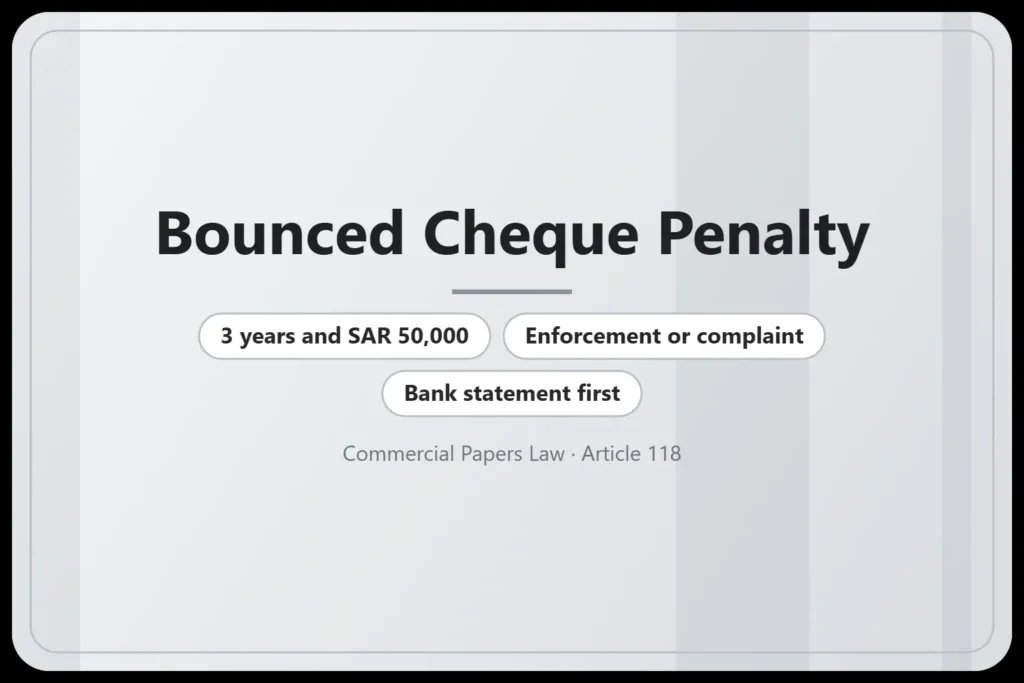
Where one of the cases in Article 118 of the Commercial Papers Law is made out, the penalty can reach imprisonment for up to three years and a fine of up to SAR 50,000, or either.
Collecting the cheque’s value is a different track from the criminal penalty. A cheque may be an enforceable instrument that can be filed through Najiz, while other cases call for a criminal complaint, a financial claim or a settlement.
This guide covers the penalty, when a cheque is an offence, enforcement versus complaint, the Najiz steps, the official fees, old and post-dated cheques, and what to organise before acting.
Quick answer: what is the bounced cheque penalty in Saudi Arabia?
Where one of the cases in Article 118 applies together with bad faith, the penalty reaches imprisonment of not more than three years and a fine of not more than SAR 50,000, or one of the two. Recovering the cheque’s value is a separate route that can start with an enforcement request if the cheque is valid as an enforceable instrument.
Do you hold a rejected cheque and are unsure whether to start with enforcement or a complaint? Start with the cheque, the bank’s statement and the relationship behind it, then decide whether the aim is to collect the value or to address the act. A lawyer can review these and choose the route.
What is the ruling on a bounced cheque in Saudi Arabia?
The ruling on the bounced cheque penalty in Saudi Arabia is not decided by the word “returned” alone. First find out why the bank refused to pay, then examine what the drawer, beneficiary or holder did, and whether it falls within the acts the Commercial Papers Law punishes, with bad faith.
Non-payment may be due to insufficient funds, a signature or data problem, a stop-payment order or another banking reason. That is why the bank’s statement of the reason for non-payment is the central document before choosing enforcement or a complaint. The law also governs the cheque’s required data, its presentation, payment and recourse when it is not paid.
The bounced cheque penalty in Saudi Arabia under Article 118
| Case | Upper limit |
|---|---|
| One of the cases in Article 118 | Imprisonment up to 3 years and a fine up to SAR 50,000, or either |
| Repeat offence within 3 years of the earlier judgment | Imprisonment up to 5 years and a fine up to SAR 100,000, or either |
The bounced cheque penalty in Saudi Arabia is set by maximum limits, not a fixed punishment in every case. The actual judgment depends on the proved act, bad faith, the evidence and the circumstances before the competent court. The official text of the Commercial Papers Law should be checked.
When is a cheque without funds an offence under the bounced cheque penalty in Saudi Arabia?
The penalty attaches when the case is within the acts described in Article 118 and bad faith is present. A debt or a later financial difficulty is not enough on its own; the facts must match the legal text. The cases include:
- Issuing a cheque without existing and available funds, or with funds below its value.
- Withdrawing the funds after issue, wholly or partly, so that the balance is insufficient.
- Issuing a stop-payment order in the circumstances the law criminalises.
- Deliberately writing or signing the cheque so that it cannot be paid.
- Endorsing or delivering a cheque knowing there are insufficient funds or that it cannot be cashed.
- A beneficiary or holder accepting a cheque knowing there are insufficient funds, in the case the text addresses.
The criminal description should therefore not rest on the image of the cheque alone, but on the bank’s statement, the correspondence, the original relationship and what was done before or after issue.
Is every returned cheque an offence?
No. “Returned” describes the result, that the cheque was not paid. It is not a separate criminal finding. A cheque may be refused for reasons that do not fall within Article 118, so the reason must be known before saying the bounced cheque penalty in Saudi Arabia applies.
It is also necessary to check that the cheque has the statutory data, such as the word “cheque”, an order to pay a fixed sum, the name of the drawee, the place of payment, the date and place of issue and the drawer’s signature.
Enforcement, complaint or claim: which route fits the bounced cheque penalty in Saudi Arabia?
One cheque can have several legal aspects, so decide your aim before you begin. If the aim is to collect the amount, the route differs from the aim of holding someone accountable for a criminal act.
| Route | Aim | When it fits best |
|---|---|---|
| Enforcement | Collect the value of the cheque | The cheque is an enforceable instrument that meets its requirements |
| Criminal complaint | Accountability for a criminal act | One of the Article 118 cases appears with bad faith |
| Financial claim | Claim the underlying debt or relationship | The dispute is wider than the cheque itself |
| Settlement | Organise payment or end the dispute | The parties agree on payment or a schedule that can be proved |
Bounced cheque enforcement through Najiz
The Ministry of Justice allows an enforceable instrument to be submitted electronically through the service “submit an enforcement request”. Cheques are among the commercial papers that can be enforceable instruments when they meet the legal requirements. The published steps are:
- Sign in to Najiz through National Single Sign-On.
- Choose all e-services.
- Open the enforcement package.
- Select “submit an enforcement request”, then “new request”.
- Choose the type of request and the type of instrument.
- Enter the applicant’s details.
- Enter the debtor’s details.
- Enter the content of the request and attach a copy of the instrument and required documents.
- Submit and keep the request number to follow it.
Official fees and timing for the enforcement request
The following reflects the Ministry of Justice service page and the Judicial Costs regulation as understood when this page was prepared. It is not a promise of how long collection will take.
| Item | Official detail |
|---|---|
| Time for the request service | Two working days |
| Cost of the electronic service | Free |
| Judicial costs for other enforcement requests | 2% of the claim, minimum SAR 500, maximum SAR 10,000 |
| Who bears the cost | Normally the debtor, unless the applicant is shown not to be entitled to the claim or part of it |
Practical requirements include a complete Najiz profile, an active IBAN linked to the applicant, the documents required for the type of instrument, a valid power of attorney if an agent submits, and the debtor’s details.
Why the bank’s statement matters
The bank’s statement shows the reason for non-payment, and the reason can change how the bounced cheque penalty in Saudi Arabia is read.
Insufficient funds differs from a problem with the signature, data or account, and a stop-payment order has to be examined for its cause and circumstances.
Keep a clear statement from the bank together with the original cheque or a copy, rather than acting on a short rejection notice.
How long does a cheque stay valid for presentation?
Article 103 of the Commercial Papers Law provides that a cheque drawn in the Kingdom and payable there must be presented within one month of the issue date shown on it.
If it is drawn outside the Kingdom and payable in it, the period is three months. A cheque is payable on sight under Article 102, so a post-dated entry alone does not change its nature. See the official text of the law.
What if the cheque is old?
The age of a cheque does not lead to one result in every case of the bounced cheque penalty in Saudi Arabia. Examine the issue date, when it was presented, the reason it was not paid, the periods that apply to recourse, and the original relationship behind it.
Some rights on the instrument may be affected by lapse of time, while financial rights tied to a separate contract or debt may remain. Passage of a period is not an automatic end of every claim without looking at its legal basis.
Does a security or post-dated cheque avoid the penalty?
Describing a cheque between the parties as a “security cheque” does not settle liability under the bounced cheque penalty in Saudi Arabia by itself.
Examine why it was issued, the agreement under which it was given, when it was presented, why the bank refused it and whether an Article 118 case is made out.
Because Article 102 makes a cheque payable on sight, any entry to the contrary is treated according to the law, so do not rely on the label alone.
Documents to organise before you act
Before deciding whether the bounced cheque penalty in Saudi Arabia applies, or whether enforcement or a claim is the better route, organise the documents that show why the cheque was issued and why it was not paid:
- The original cheque or a clear copy.
- The bank’s statement of the reason for non-payment.
- The details of the drawer and the beneficiary.
- The contract, invoice or document behind the cheque.
- Messages about payment or objection.
- Proof of any part payment.
- Any earlier settlement or payment schedule.
If your focus is collection and enforcement rather than the criminal side, review the scope of a debt collection and enforcement lawyer in Saudi Arabia. Where the dispute is about the underlying debt, a financial claim is a separate route.
Note on the new Enforcement Law
A new Enforcement Law was published in Umm Al-Qura in May 2026 and, under its Article 65, takes effect 180 days after publication, which is reported to have been at the end of October 2026. The new law is understood to keep cheques among enforceable instruments (Article 7), so procedures and costs may differ from the description above; check the current Najiz service page before filing.
Common mistakes in the bounced cheque penalty in Saudi Arabia
- Treating every returned cheque as an offence. Read the reason for non-payment first.
- Confusing enforcement with the penalty. Enforcement collects the right and a complaint concerns the criminal act.
- Filing a financial claim before checking the enforceable instrument. Enforcement may be the closer route to the cheque’s value.
- Ignoring the bank’s statement. It explains the non-payment.
- Relying on the label “security cheque”. The name alone does not settle the effect.
- Neglecting issue and presentation dates. The law attaches effects to the periods.
- Not documenting a settlement. Keep proof of any payment or new agreement.
What should the cheque holder do after rejection?
On the bounced cheque penalty in Saudi Arabia, the holder should first obtain the reason from the bank and keep the cheque and related documents.
Then decide whether the aim is to collect the value, whether a criminal act exists, or whether the dispute is tied to a wider contract or debt.
Separating the aims avoids unnecessary procedures and stops a financial claim being mixed with a different criminal route.
What should the drawer do when the cheque is presented against him?
The drawer should organise a copy of the cheque, the bank’s statement, the relationship behind it and any payment, settlement or correspondence. Saying the cheque was for “security” or that the debt is not due is not enough without documents. How the file is handled depends on whether the dispute concerns the debt itself, the validity of enforcement or the act alleged on the criminal side.
Frequently asked questions
What is the bounced cheque penalty in Saudi Arabia?
Where one of the cases in Article 118 applies with bad faith, the penalty can reach imprisonment of not more than three years and a fine of not more than SAR 50,000, or either. A repeat offence within three years of the judgment can raise the limits to five years and SAR 100,000.
Is every returned cheque a cheque without funds?
No. "Returned" means the bank did not pay, but the reason may differ. Criminal liability needs the reason for non-payment and whether an Article 118 case applies, so obtain the bank's statement and do not rely on a short rejection notice.
Can a cheque be enforced directly through Najiz?
Yes, if it meets the requirements of an enforceable instrument. The Ministry of Justice offers the service of submitting an enforcement request on Najiz. This differs from a criminal complaint because enforcement mainly aims to recover the money.
Is enforcing a cheque through Najiz free?
The electronic service itself is listed as free on the national platform, but this does not mean there are no judicial costs. The current regulation sets other enforcement costs at 2% of the claim, minimum SAR 500 and maximum SAR 10,000.
What if the cheque is old?
Start with the issue date, when it was presented and why it was not paid. The Commercial Papers Law sets periods for presenting a cheque and for some recourse actions, but an old cheque does not automatically end every financial right.
Does the new Enforcement Law change this?
A new Enforcement Law took effect around the end of October 2026 and is understood to keep cheques among enforceable instruments. Procedures and costs may differ from earlier descriptions, so check the current Najiz service page.
Read the reason for non-payment first
The bounced cheque penalty in Saudi Arabia reaches imprisonment of up to three years, a fine of up to SAR 50,000, or both, where an Article 118 case and bad faith are made out, and it differs from simply being a returned cheque. Begin with the bank’s reason for refusing payment, examine the cheque, and decide whether the aim is collection, accountability or settlement.
Need to review a rejected cheque before you act? Send us the cheque, the bank’s statement and the document behind it on WhatsApp and a lawyer will assess the route between enforcement and defence. You can also browse our legal services.

Mohammed Aboud Al-Dossary is an experienced Saudi lawyer with more than 15 years of legal experience in practice and legal consultancy. He is currently General Manager of Mohammed Aboud Al-Dossary Law Firm and Legal Consultancy, which provides specialized legal services in a range of fields, including corporate matters, criminal cases, intellectual property, family cases and commercial disputes.
The firm provides integrated legal consultancy for individuals and companies in the Kingdom of Saudi Arabia. In his work, Mohammed Aboud Al-Dossary focuses on close attention to the details of each case and on pursuing justice for his clients.
His legal experience
More than 15 years practicing law in the Kingdom of Saudi Arabia.
Specialized legal consultations for individuals and companies.
Expert in commercial arbitration, litigation and criminal cases.
Team leader in handling complex cases across the Kingdom’s courts.
Chairman of the Board
As founder and general manager of Mohammed Aboud Al-Dossary Law Firm and Legal Consultancy, he supervises all legal operations and directs a team of lawyers.