Resignation in Saudi Labor Law is a written request by the worker to end the employment contract of his own will. It is not an unlimited right that takes effect the day it is handed in. The law sets rules on acceptance, silence, deferral, withdrawal, notice, the type of contract and what is owed afterwards.
A worker searching for this usually wants practical answers. Is it enough to submit the request? Can the employer refuse it? When does it take effect? Is end-of-service pay still due? This guide covers private-sector workers under the Saudi Labor Law and leaves aside civil-service and military rules.
Quick answer: how resignation in Saudi Labor Law works
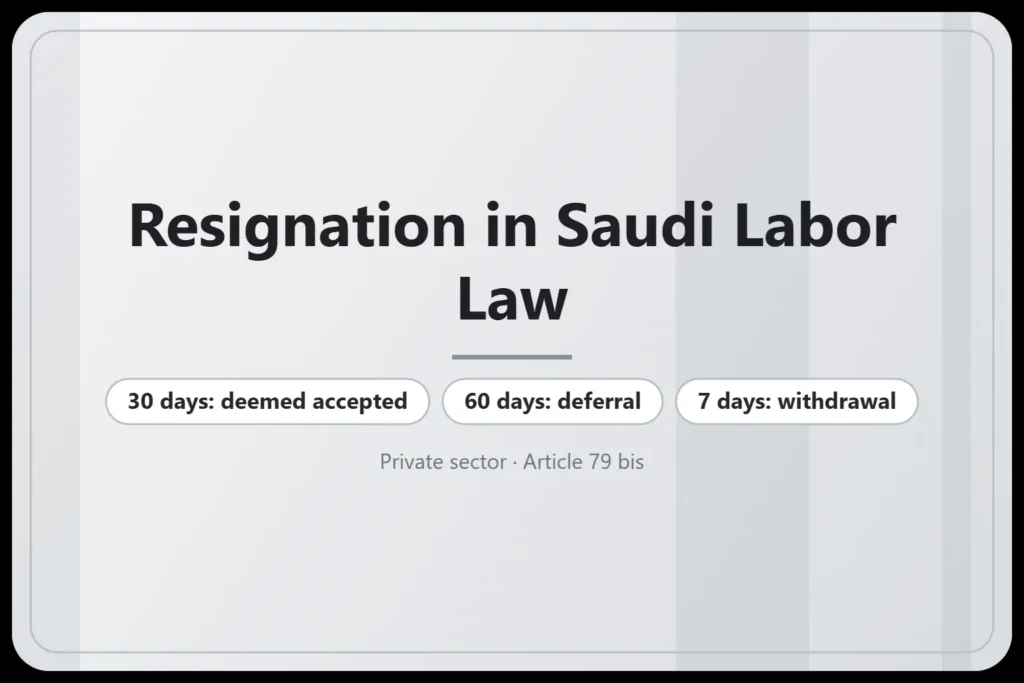
Under Article 79 bis, a resignation request is deemed accepted if the employer does not reply within 30 days of submission.
The employer may defer acceptance for up to 60 days where it has a legitimate written justification connected with the needs of the work. The worker may withdraw the request within 7 days unless it has already been accepted.
The contract stays in force during these periods unless the law provides otherwise.
| Rule | Period | What it means |
|---|---|---|
| Deemed acceptance | 30 days | No employer reply within 30 days of submission |
| Deferral by the employer | Up to 60 days | Needs a legitimate, written justification |
| Withdrawal by the worker | 7 days | Only if the request has not been accepted before |
Are you about to resign and worried about losing your dues or starting a dispute with your employer? A labor lawyer can review your contract, timeline and dues and help you resign correctly under the Saudi Labor Law.
What resignation in Saudi Labor Law means
Resignation in Saudi Labor Law is a declared legal act by which the worker ends the contractual relationship by the route the law lays down. It is not the same as simply leaving work or stopping attendance. Resignation produces effects that can be traced: the date of submission, the time to reply, the notice, and the dues. Unorganised absence can open a different kind of dispute.
The first practical question is therefore not “should I leave?” but “how do I resign in a way that can be proved and cannot later turn into a labor dispute?”.
Saudi Labor Law termination of contract and resignation: the differences
| Term | Meaning | Key point |
|---|---|---|
| Termination of the contract | The general term for any way the relationship ends | The wider frame that includes resignation, cancellation and expiry |
| Resignation | Ending the contract by the worker’s will | Every resignation is one form of termination |
| Cancellation | Ending the contract for a legitimate reason or breach | Tied to a specific legal ground |
| Expiry of the term | The relationship ends when the agreed term runs out | Not a resignation |
| Agreement to end | Employer and worker both agree to end it | Does not come from the worker alone |
| Abandoning work | Absence without a proper route | Not a resignation, and can have different effects |
When does the relationship actually end?
It does not always end on the day the resignation is submitted. The end may depend on acceptance, on 30 days passing without a reply, on the end of a lawful deferral, on the notice period, or on a later date properly agreed. So the better question is not “did I submit it?” but “when did it take effect?”.
Conditions for a valid resignation in Saudi Labor Law
For a resignation to be valid and effective, the worker should do more than decide privately to leave. The essentials are that it is in writing, comes from free will, can be traced, and follows the legal route for acceptance, silence, deferral or withdrawal.
- In writing and clear. The writing proves that the worker asked to resign, the date of submission, when the periods start to run, and the exact wording.
- Free will. A resignation obtained by coercion, deception or pressure that removes the worker’s freedom of choice is open to challenge. A dispute over this can turn the file from a completed resignation into a dispute over validity.
In practice the best resignation letter includes the worker’s name, the date, a clear statement of the wish to resign, the proposed effective date if any, and a method of delivery that can be proved.
Acceptance, deferral and silence in resignation in Saudi Labor Law
When is a resignation accepted automatically?
If a valid resignation is submitted and the employer does not reply within 30 days of submission, it is deemed accepted. The same article now links silence to a time limit and attaches an effect to it, which is why proof of the submission date and method matters.
Can the employer refuse a resignation?
It is more accurate not to describe this as an absolute refusal. The law regulates acceptance and deferral and does not leave the request open-ended at the employer’s discretion. The employer’s position must be read against the text of the law, not on the basis that a request can be held indefinitely.
When may acceptance be deferred?
The employer may defer acceptance for up to 60 days where it has a legitimate written justification linked to the interest of the work. The deferral is therefore disciplined, reasoned and capped, not an open suspension. Your records should show when the written justification was given.
What if the employer does not reply?
Silence does not leave the worker in a legal vacuum, because it is tied to a period and an effect. Keep proof of the submission date, the delivery method, any reply or lack of one, and do not rely on verbal communication.
Can resignation in Saudi Labor Law be withdrawn?
Yes. The worker may withdraw the resignation within 7 days of submitting it, unless it was accepted before then. The law does not bind the worker to a request he regrets days later, but the right is limited by that period.
The right is lost if the 7 days pass or if the resignation was validly accepted first. After that, staying in the job may need a new agreement between the worker and the employer, rather than a withdrawal.
Notice period for resignation in Saudi Labor Law
Notice for resignation in Saudi Labor Law depends on the contract and on how wages are paid. Under Article 75, as amended, for an open-ended contract paid monthly the worker must give at least 30 days’ written notice, and an employer who ends the contract must give at least 60 days. Where pay is not monthly, the notice is at least 30 days.
Read the contract before applying any figure, because the type of contract, the method of payment and the person ending it all matter. A fixed-term contract ended early may bring financial consequences under the contract and the law.
Rights and duties during the notice period
The contract stays in force during notice. Wages, duties and workplace discipline continue. Not serving the notice period may lead to compensation depending on the case, so a worker should not assume that handing in a resignation allows him to stop working immediately.
End-of-service pay after resignation in Saudi Labor Law
Under the rules on resignation in Saudi Labor Law, whether a resigning worker receives end-of-service benefits depends on length of service and on how the relationship ended, so general statements such as “resignation cancels the gratuity” are wrong. Article 84 sets the basic gratuity, half a month’s wage for each of the first five years and a month’s wage for each year after that.
Under Article 85, as commonly applied, a worker who resigns receives nothing if his service is under two years, one third of the gratuity for two years up to five, two thirds for five up to ten, and the full gratuity from ten years. Check the current text when calculating.
Article 87 provides limited exceptions that restore the full gratuity, for example when a worker leaves because of circumstances beyond his control or, for a female worker, within set periods after marriage or childbirth. Where the worker ended the contract, final dues must be settled within two weeks. See the wider rules in our guide to the Saudi Labor Law.
Special situations need closer reading than an ordinary resignation, such as resigning during probation, during leave or sick leave, or because wages are late. There the question is not only whether the resignation is valid but also when the submission was made, when the periods began and whether the employer’s serious breach allows leaving without notice.
How to submit resignation in Saudi Labor Law correctly
- Write a clear dated request stating that you wish to resign.
- Send it in a way you can prove and keep a copy.
- Note the date, because the 30-day and 7-day periods run from it.
- Keep any reply, receipt or written deferral.
- Continue working through any notice period unless the law allows otherwise.
If the employer replies late or refuses, ask the practical questions first: was the request in writing, can the date be proved, have the periods passed, was there an explicit reply, is there a written and reasoned deferral, and is the contract still running with a notice period? The answers show whether this is an effective resignation, a dispute over its effect or a dispute over dues.
Fixed-term and open-ended contracts
Resigning from a fixed-term contract differs from resigning from an open-ended one. A fixed-term contract rests on an agreed duration, so leaving before its end may carry financial consequences or compensation depending on the contract and whether there is a legitimate reason. In an open-ended contract resignation follows the normal route of notice and the general rules.
When does a resignation become a labor dispute?
A disagreement becomes a labor dispute when the parties differ over a right arising from the relationship: whether the resignation took effect, the financial dues, compensation, notice, or refusal to apply what the law provides. The worker can then seek amicable settlement and, if that fails, file a claim before the labor court.
Frequently asked questions
What is resignation in Saudi Labor Law?
It is a written request by the worker to end the contract of his own will, with consequences for acceptance, notice, withdrawal and dues.
Can a worker resign at any time?
In principle yes, but the effect and consequences depend on the law, the type of contract and the notice period.
Does the employer have to accept a resignation?
A resignation does not stay pending forever. The law regulates acceptance, silence and deferral in set cases.
When is a resignation accepted automatically?
If 30 days pass from submission without a reply from the employer, it is treated as accepted under Article 79 bis.
Can the employer defer accepting a resignation?
Yes, for up to 60 days with a legitimate written justification, within the conditions the law sets.
Can I withdraw my resignation?
Yes, within 7 days of submitting it, unless it was accepted before then.
Resign in writing and keep the dates
Resignation in Saudi Labor Law is a right, but it is not an instant exit. It depends on writing, acceptance or silence, possible deferral, the 7-day withdrawal right, notice, the contract type and the final dues. Keep proof of the submission date and read your contract before you act.
Planning to resign and unsure about your dues? Send us your contract, resignation letter and dates on WhatsApp and a labor lawyer will check the route and your final dues. You can also browse our legal services.

Mohammed Aboud Al-Dossary is an experienced Saudi lawyer with more than 15 years of legal experience in practice and legal consultancy. He is currently General Manager of Mohammed Aboud Al-Dossary Law Firm and Legal Consultancy, which provides specialized legal services in a range of fields, including corporate matters, criminal cases, intellectual property, family cases and commercial disputes.
The firm provides integrated legal consultancy for individuals and companies in the Kingdom of Saudi Arabia. In his work, Mohammed Aboud Al-Dossary focuses on close attention to the details of each case and on pursuing justice for his clients.
His legal experience
More than 15 years practicing law in the Kingdom of Saudi Arabia.
Specialized legal consultations for individuals and companies.
Expert in commercial arbitration, litigation and criminal cases.
Team leader in handling complex cases across the Kingdom’s courts.
Chairman of the Board
As founder and general manager of Mohammed Aboud Al-Dossary Law Firm and Legal Consultancy, he supervises all legal operations and directs a team of lawyers.